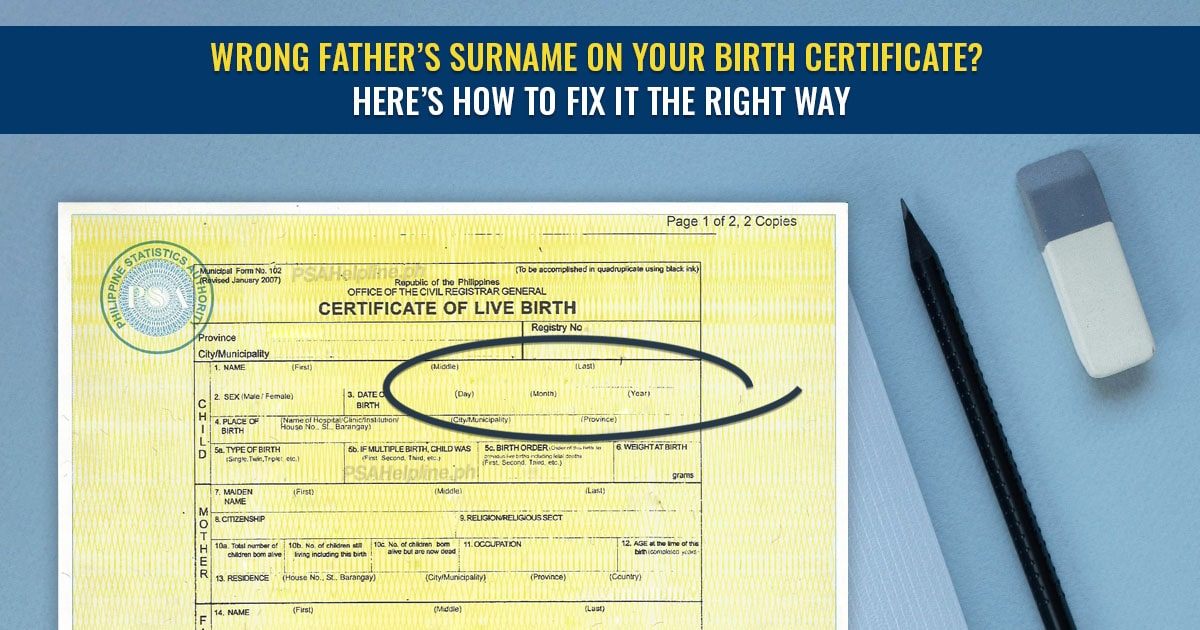
Finding a mistake on your birth certificate can be stressful, especially if it is your father’s surname. Fortunately, there is a legal process to correct minor clerical errors without going to court. You can file a correction request at the Local Civil Registry Office and later have your updated PSA certificate ordered online and delivered safely to you through PSA online ordering at PSAHelpline.ph.
Correcting errors on your PSA certificate is important because even minor mistakes can cause problems with school enrollment, job applications, government benefits, or travel documents. An incorrect father’s surname, for example, can create mismatched records or delays when your documents are verified. Ensuring your PSA certificate is accurate protects your legal identity and makes it easier to complete important transactions without unexpected complications.
Table of Contents
- Why the Father’s Surname Matters
- The Law Behind the Correction: RA 9048 and RA 10172
- What Counts as a Clerical Error?
- Who Can File the Correction?
- Step-by-Step Process to Correct the Father’s Surname
- Required Documents
- Costs and Timeline
- When a Court Case Is Needed
- Final Thoughts
Why the Father’s Surname Matters
A child’s surname is not just a name. It determines legal identity, lineage, and, in some cases, inheritance rights. Under Philippine law, legitimate children carry their father’s surname, while illegitimate children generally use their mother’s surname unless the father acknowledges them through an affidavit of acknowledgment or admission of paternity (as allowed under Republic Act No. 9255).
So, when the father’s surname on the birth certificate is incorrect even by a few letters, it can cause problems when applying for school, passports, or government benefits. The good news: if the mistake is purely clerical, you do not need to go to court to fix it.
The Law Behind the Correction: RA 9048 and RA 10172
Republic Act No. 9048, passed in 2001, allows people to correct minor clerical or typographical errors on birth certificates without filing a court case. This includes common mistakes like misspelled names, wrong middle initials, or misplaced letters. Instead of going through a judge, you file a petition directly with your local civil registrar (LCR).
In 2012, Republic Act No. 10172 expanded the law to also cover errors in the date of birth (day and month) and even the sex of a person, provided the mistake is clearly clerical.
These two laws make the process faster, more affordable, and less intimidating for ordinary Filipinos. But remember, they only apply to clerical errors. If you are trying to replace the name of one father with another, that is a different case that must go through the courts.
What Counts as a Clerical Error?
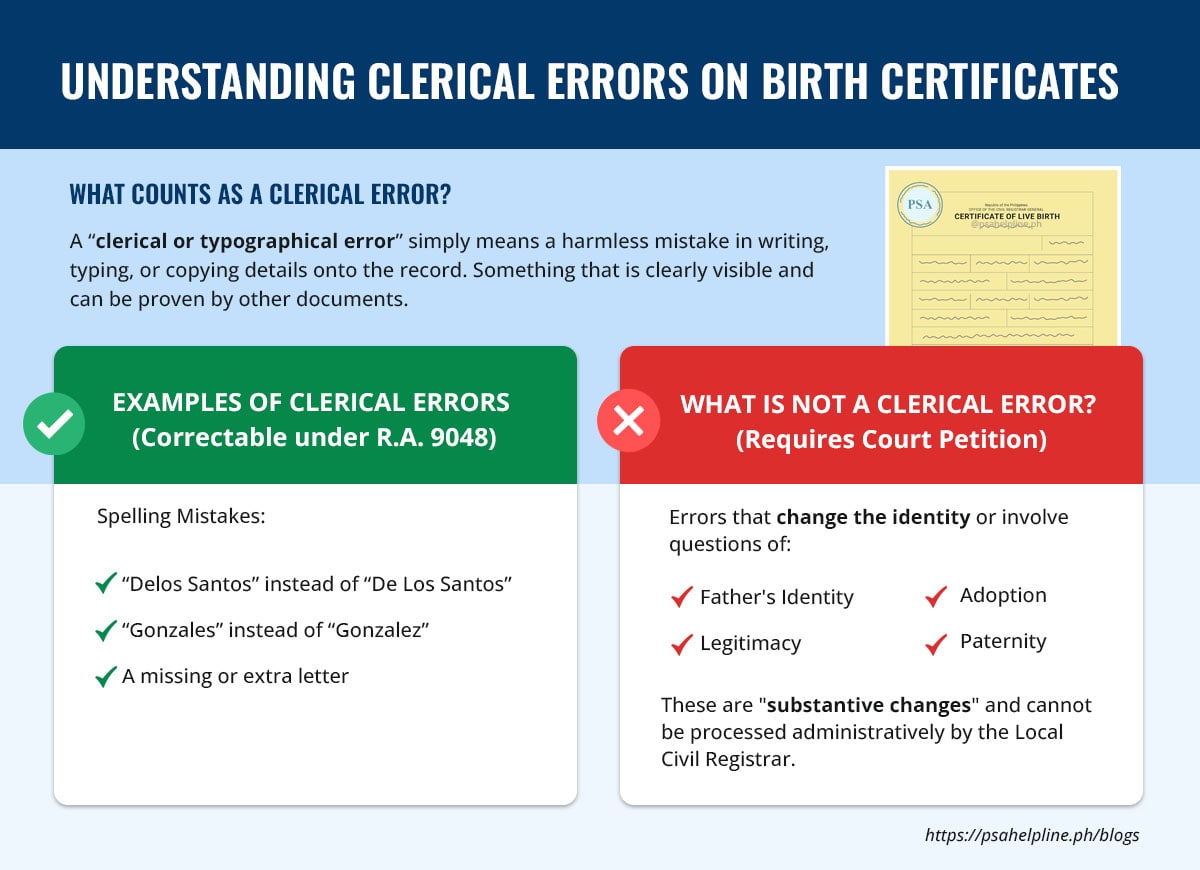
A “clerical or typographical error” simply means a harmless mistake in writing, typing, or copying details onto the record. Something that is clearly visible and can be proven by other documents. For example:
- “Delos Santos” instead of “De Los Santos”
- “Gonzales” instead of “Gonzalez”
- A missing or extra letter
But if the error would change the identity of the father entirely, or involve questions of legitimacy, adoption, or paternity, the local registrar cannot process it under RA 9048. Those are considered substantive changes and need to go through a court petition.
Who Can File the Correction?
The petition can be filed by:
- The person named in the certificate (if of legal age)
- The parent or guardian (if the person is a minor)
- A duly authorized representative (with a Special Power of Attorney)
There is no deadline for filing, but it is better to do it as soon as possible since gathering supporting documents can take time.
Step-by-Step Process to Correct the Father’s Surname
1. Visit your Local Civil Registrar (LCR).
Go to the city or municipality where the birth was originally registered. Ask for a certified copy of the birth certificate and confirm that the error is indeed clerical.
2. Prepare a Petition for Correction.
The LCR provides a standard form. You will need to fill out the incorrect entry, the correct entry, and the reason for the correction. Attach supporting documents like your father’s own birth or marriage certificate.
3. File the Petition.
Submit your documents to the same LCR (or to your current city’s registrar if you are filing as a migrant petitioner). The filing fee is around ₱1,000 for local filings and ₱3,000 for migrant cases.
4. Publish the Petition.
If the correction involves a name or surname, it must be published once a week for two consecutive weeks in a newspaper of general circulation. You will shoulder the publication cost, usually ₱2,000–₱5,000.
5. Wait for Review and Approval.
The LCR reviews your petition, and after a 10-day posting period, they issue a Certificate of Finality if no one objects. If denied, you can appeal to the Philippine Statistics Authority (PSA) within 15 days.
6. Transmittal and PSA Annotation.
Once approved, the corrected record is sent to the PSA for annotation. You can then request an updated copy of your PSA birth certificate.
7. Order the Corrected Copy.
After the PSA updates your record, you can easily order the first corrected copy by going to a PSA CRS office. All other succeeding copies you may then order through PSAHelpline.ph for PSA delivery straight to your doorstep: safe, official, and trackable.
Required Documents
When filing, prepare at least two or three supporting documents that clearly show the correct surname, such as:
- Father’s birth certificate or marriage certificate
- Baptismal certificate or school records
- Valid government IDs
- Proof of publication
- Official receipts for fees
If a representative files on your behalf, include a notarized authorization or Special Power of Attorney.
Costs and Timeline
- Filing fee: ₱1,000 (local) or ₱3,000 (migrant)
- Publication: ₱2,000–₱5,000 depending on the newspaper
- PSA copy fee: ₱155–₱330 per copy
- Notarization: ₱100–₱200
Most cases are completed within one to three months, though it can take longer depending on your LCR’s workload and the completeness of your documents.
When a Court Case Is Needed
If the correction would identify a completely different father or affect legitimacy, the change cannot be made under RA 9048 or RA 10172. In that case, you will need to file a Petition for Correction of Entry under Rule 108 of the Rules of Court in your local Regional Trial Court. This process can take six months or more and costs significantly more, but it is required for major corrections like paternity disputes.
Final Thoughts
Getting a father’s surname corrected on a birth certificate might seem complicated, but if the mistake is purely clerical, the process is straightforward and does not require a lawyer. Just make sure your documents are complete and consistent. Once approved, you can conveniently get your corrected record through PSAHelpline.ph, the trusted platform for PSA online ordering and delivery of birth, marriage, CENOMAR, and death certificates.
Having the correct information on your PSA record ensures your legal identity is protected and with online tools now available, making that correction is easier than ever.