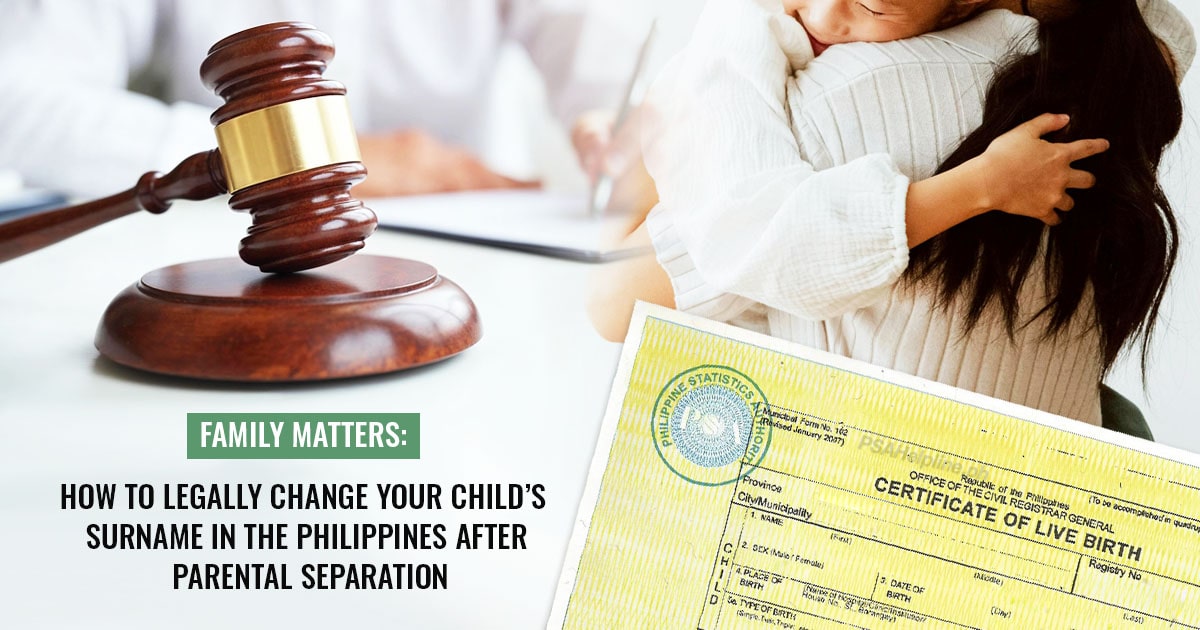
Parental separation is never easy, but amidst all the changes, one thing remains constant: the rules governing your child’s legal name. Contrary to popular belief, separation, annulment, or getting a custody order does not automatically change your child’s surname.
If you are a parent in the Philippines looking to update your child’s legal records, you must follow one of the three lawful pathways outlined in Philippine law.
This guide simplifies the complex rules and processes, so you can focus on securing a PSA-issued annotated birth certificate reflecting the desired change.
Table of Contents
- The Big Picture: Why Separation Does Not Automatically Change a Name
- Default Surname Rules: Before Any Change
- Pathway 1: The Administrative Route (R.A. 9255) for Illegitimate Children
- The Affidavit to Use the Surname of the Father (AUSF)
- Consent and Documentation
- Results and Important Note on Parental Authority
- Pathway 2: The Judicial Route (Rule 103) For All Other Cases
- Pathway 3: Name Change Through Adoption
- What Documents You Need (The Must-haves)
- Common Pitfalls and Frequently Asked Questions (FAQs)
The Big Picture: Why Separation Does Not Automatically Change a Name
Dealing with separation is complicated enough without adding legal hurdles, but when it comes to your child’s name, the law is specific. The simple truth is that ending a marriage or relationship, whether through separation, annulment, or a foreign divorce being recognized, has zero effect on the child’s surname.
The child’s surname follows the rules set by the Civil Code and the Family Code. If you want a change, you need new, formal legal action. There are only three legal doors available for changing a child’s name:
- Administrative Filing (R.A. 9255) – This is the fast track, but only for illegitimate children who want to use their biological father’s surname.
- Going to Court (Rule 103): This is the route for almost every other situation, especially for legitimate children, requiring a judge’s approval based on the child’s best interests.
- Adoption (R.A. 11642): The name change happens naturally as part of the adoption process.
Do not waste your time trying to fix a surname using clerical correction laws. Laws like R.A. 9048, as amended by R.A. 10172, are meant for simple typos and fixing first names, they do not allow for a full surname change, except as specifically allowed under R.A. 9255.
Default Surname Rules: Before Any Change
To figure out your next step, you first need to confirm the child’s current legal status:
- Legitimate Child (Parents married at the time of conception or birth): By default, the child carries the father’s surname.
- Illegitimate Child (Parents were not married): The child’s default name is the mother’s surname.
The law R.A. 9255 gives an illegitimate child the option to use the father’s surname if he formally acknowledges them. However, here is a crucial point: even if the child takes the father’s name, their legal status as an illegitimate child does not change, and the mother retains sole parental authority.
The Administrative Route (R.A. 9255) For Illegitimate Children
This is the most straightforward option, designed only for one scenario: an illegitimate child whose biological father has recognized them and who wishes to use his surname.
The Affidavit to Use the Surname of the Father (AUSF)

This is the key piece of paper. The father must complete and file the AUSF with the Local Civil Registry Office (LCRO) where the child’s birth is recorded. After successful filing, the LCRO works with the Philippine Statistics Authority (PSA) to annotate the record.
Once this administrative step is finalized, you can request your PSA certificate online through services like PSAHelpline.ph for convenient PSA delivery of the correct, annotated PSA birth certificate.
Consent and Documentation
Who needs to sign off depends on the child’s age:
- Ages 0-6: Only the mother’s consent (plus the father’s AUSF) is required
- Ages 7-17: Both the mother’s consent and the child’s written consent are required
- Ages 18+: The adult child can file the request by themselves
Results and Important Note on Parental Authority
If the process is successful, the official PSA birth certificate will now show the child using the father’s surname.
Despite the name change under R.A. 9255, the child remains illegitimate, and the mother keeps sole parental authority. Also, remember that this administrative route is a one-way street: you cannot use it to switch back to the mother’s surname; that requires going to court.
The Judicial Route (Rule 103) for All Other Cases
If your goal involves anything other than an illegitimate child taking the father’s surname (for instance, a legitimate child moving to the mother’s name), you will need to go through the courts. This means filing a formal petition in the Regional Trial Court (RTC) where you live.
When a Court Petition is Required
A court case is necessary if:
- Your child is legitimate and wants to switch to the mother’s surname.
- The child wants to use a hyphenated surname.
- You are trying to revert an illegitimate child’s surname back to the mother’s after they initially used the father’s.
- The change is being sought due to the father’s abandonment, abuse, or other compelling reasons.
The “Best Interest of the Child” Standard
In court, you must demonstrate a proper and reasonable cause, with the judge always focusing on what is truly best for the child. Valid reasons that courts have accepted include:
- The current surname is causing the child embarrassment or ridicule (think bullying).
- The child is widely known by another surname in school and the community, and the change will prevent confusion.
- Evidence of serious misconduct, abandonment, or lack of support from the father.
- The need to match records for immigration or foreign school enrollment.
Be prepared for the legal process: the court will notify the local civil registrar and the Office of the Solicitor General (OSG), and you must publish the petition in a newspaper for three weeks. If the judge grants your request, their order will direct the PSA to issue an annotated record.
Name Change Through Adoption
If the plan involves a permanent change, such as a mother’s new husband adopting the child (step-parent adoption), the name change happens automatically.
Thanks to the new R.A. 11642 (Domestic Administrative Adoption Act), many adoptions are now handled through the National Authority for Child Care (NACC). Once the adoption is finalized, the PSA issues an amended birth certificate where the child officially takes the adopter’s surname and is legally recognized as their child.
What Documents You Need (The Must-haves)
No matter which path you take, preparation is key. Make sure you have these documents ready:
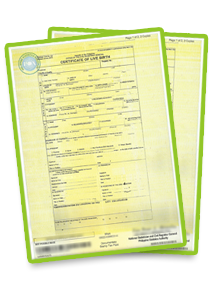
- The child’s current official PSA birth certificate
- Valid IDs of all parties involved (parents, father for AUSF, child if of age)
- The AUSF document and proof of father’s acknowledgment (for R.A. 9255 cases)
- All necessary consents (mother and child, based on age)
- For court cases, all supporting evidence (school records, proof of non-support, protective orders, etc.)
After the name change is legally approved and recorded, you will need a fresh copy showing the update. Order your PSA birth certificate through an official channel like PSAHelpline.ph for convenient online processing and reliable PSA delivery to your doorstep.
Common Pitfalls and Frequently Asked Questions (FAQs)
Q: “We are separated. Can I just change my legitimate child’s surname to mine?”
A: Absolutely not automatically. If the child is legitimate, you must file a Rule 103 court petition. You will need to provide solid evidence to the judge that this change serves the child’s best interests.
Q: “My child is illegitimate and already uses my surname (the mother’s). Do I need the father’s approval to keep it this way?”
A: No. The law establishes the mother’s surname as the legal default for an illegitimate child. No action or consent from the father is required to simply retain the mother’s surname.
Q: “The father is abusive. Do I need his cooperation for a name change?”
A: If you are using the court route (Rule 103), documented proof of abuse, violence, or abandonment (like a VAWC protection order) can be strong evidence in support of your petition, arguing the change is in the child’s best interest.
Q: “Can custody orders alone authorize a surname change?”
A: No. Custody dictates who cares for the child, but it does not give you the power to change the legal surname. A surname change requires one of the three specific legal pathways outlined above.