Table of Contents
- The One Rule You Can’t Break
- Your Lawful Choices
- The Philippine Wedding Plan (Fly-in)
- The Foreign Wedding Plan (Report It)
- The Report of Marriage Process
- Common Roadblocks: Prior Marriages and Capacity Issues
- The Post-wed
The One Rule You Cannot Break
Planning a wedding is tough enough, but when your fiancé lives overseas, the Philippines has a non-negotiable legal rule that simplifies (and sometimes complicates) everything:
The No-Show, No-Go Rule
Philippine law absolutely forbids proxy marriages. At the moment you exchange vows, both you and your fiancé must be physically present before the solemnizing officer. No video calls, no powers of attorney, no exceptions. If one of you cannot be at the wedding, it cannot legally happen here.
This leaves couples with a clear choice, based on the principle of lex loci celebrationis (the law of the place where the marriage occurred): You either marry in the Philippines (with both parties present) or you marry abroad (where they live) and then officially register the foreign marriage here.
Your Two Lawful Choices
Your decision boils down to logistics:
| Choice | Best For… | Key Action |
|---|---|---|
| Path 1: Marry in the Philippines | Couples who want a local church or civil ceremony and can schedule their fiance’s trip to cover the 10-day license posting. | The foreign fiancé flies in and stays long enough to complete the license application process and the ceremony. |
| Path 2: Marry Abroad | Couples where the Filipino partner can easily travel, or if the foreign country’s marriage process is simpler. | You marry under foreign law, and then formally Report the Marriage (ROM) to the nearest Philippine Embassy or Consulate. |
The Philippine Wedding Plan (Fly-in)
If you decide to get married locally, the clock starts ticking the moment you apply for the Marriage License.
The Marriage License Timeline
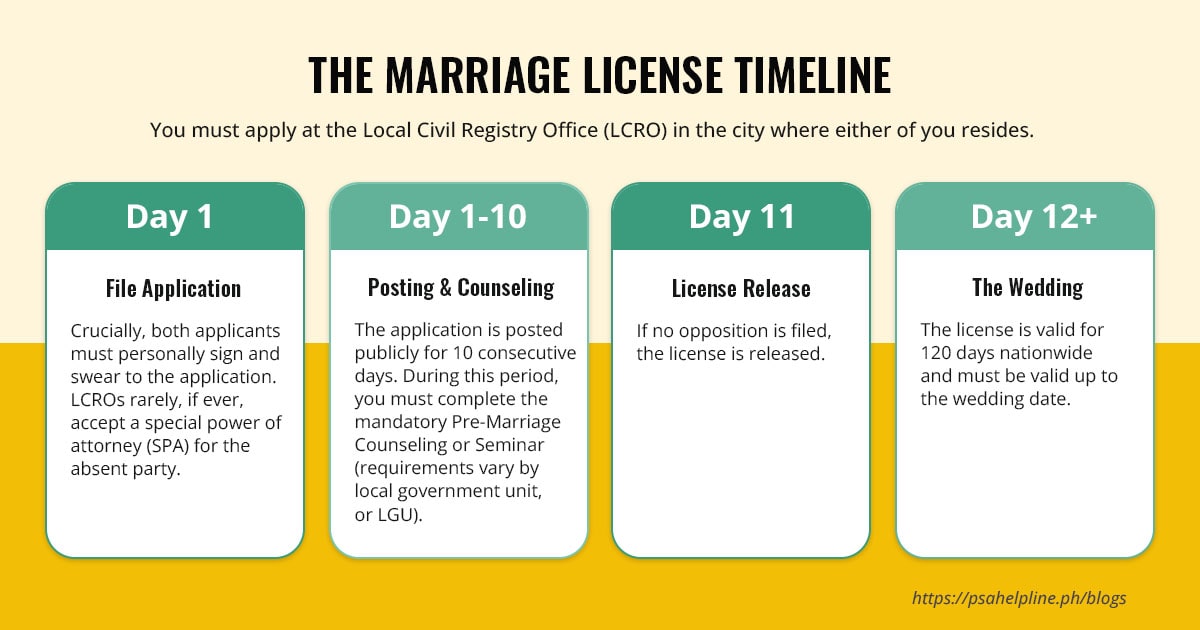
You must apply at the Local Civil Registry Office (LCRO) in the city where either of you resides.
- Day 1: File Application. Crucially, both applicants must personally sign and swear to the application. LCROs rarely, if ever, accept a special power of attorney (SPA) for the absent party.
- Day 1-10: Posting & Counseling. The application is posted publicly for 10 consecutive days. During this period, you must complete the mandatory Pre-Marriage Counseling or Seminar (requirements vary by local government unit, or LGU).
- Day 11: License Release. If no opposition is filed, the license is released.
- Day 12+: The Wedding. The license is valid for 120 days nationwide and must be valid up to the wedding date.
When your fiancé books their flight, build buffer days. Do not schedule the wedding for Day 11. Give yourselves time for seminars, possible document issues, and travel delays.
The Essential Paperwork Checklist
Here are the minimum documents required for a civil wedding:
For the Filipino Applicant
- Recent PSA birth certificate
- PSA CENOMAR (Certificate of No Marriage) issued within six months from the PSA. If previously married, you must show the PSA marriage certificate with the PSA-annotated final annulment or nullity decree (or court-recognized foreign divorce)
- Valid government ID showing your residence
- Seminar Certificate (pre-marriage counseling)
- If age 18-20: Written, sworn Parental Consent
- If age 21-25: Written Parental Advice (lack of advice may delay license)
For the Foreign Applicant
- Valid Passport (bio page)
- Certificate of Legal Capacity to Contract Marriage (or an Affidavit in Lieu if their embassy does not issue one). This is a must.
- Action Step: If this certificate was issued abroad, it must be apostilled (or consularized, depending on the country).
- Apostilled/Consularized Birth Certificate and proof of civil status (like a final divorce decree or spouse’s death certificate).
The Foreign Wedding Plan (Report It)
If you get married overseas, the marriage is generally valid in the Philippines, provided it was valid in the country where it took place and does not violate Philippine public policy.
The Report of Marriage (ROM) Process
This is how you make your foreign marriage official with the PSA.
- Marry: Comply with the foreign jurisdiction’s rules to obtain a legal foreign Marriage Certificate.
- Report: File a Report of Marriage (ROM) at the nearest Philippine Embassy or Consulate that has jurisdiction over the place where you got married.
- Timeline: Report it preferably within one year (late reports are accepted with written explanation).
Typical ROM Filings:
- Completed ROM forms (often four copies).
- The Foreign Marriage Certificate (official copy), which must be apostilled or consularized by the host country or embassy.
- PSA birth certificate of the Filipino spouse.
- Passports and IDs.
- Proof of the termination of any prior marriage (with the necessary Philippine court recognition and PSA annotation, if applicable).
The Embassy sends the ROM to the DFA, which then forwards it to the PSA. Once the PSA encodes it, you can finally request your PSA marriage certificate.
Common Roadblocks:
The biggest delays happen when a previous marriage was not properly terminated in the eyes of Philippine law.
| Prior Marriage Status | The Legal Requirement | What LCROs Look For |
|---|---|---|
| Philippine Annulment/Nullity | Must be final and executory | The LCRO requires the PSA-annotated previous marriage certificate. The annotation proves you are legally single. |
| Foreign Divorce (Filipino spouse was involved) | You must obtain judicial recognition of that foreign divorce in a Philippine court (RTC) before remarrying here. | The LCRO requires the PSA annotation showing the divorce was recognized. No annotation, no license. |
| Foreign Divorce (Foreign spouse obtained it) | While Article 26(2) allows the Filipino to remarry, you still need the Philippine judicial recognition and PSA annotation to update your civil status here. | The same annotation is required. This is a common pitfall. |
The Post-Wedding Checklist: Names, IDs, and Updates
Once you have your official PSA Marriage Certificate, you need to get your life in sync:
- Name Change – Remember, Philippine law allows (but does not require) a wife to adopt the husband’s surname. Choose only one style (maiden, married, or composite) and use it consistently.
- Update IDs – Start with your primary IDs and records. Passport, PhilID, SSS/GSIS, PhilHealth, Pag-IBIG, LTO (Driver’s License), and BIR (if changing name for tax purposes).
- Use PSA documents – For banks and immigration purposes (like visa applications), always present the official PSA marriage certificate.
Conclusion
Cross-border love requires a meticulous paper trail, but the process is clean and lawful if you follow one of the two paths.
If you bring your fiancé home, plan the travel around the mandatory 10-day license posting. If you marry abroad, diligently file the Report of Marriage and actively track its transmittal to the PSA.
Crucially, resolve all prior marriage issues (especially foreign divorce recognition and PSA annotation) before you even apply for a license. Do this, and your path to a recognized marriage in the Philippines will be smooth and seamless.