Table of Contents
- What Really is Your Legal Name?
- The Power of the PSA Birth Certificate
- The Essential Rules You Need to Know
- Common Name Conflicts
- The Official Routes to a Name Change
- Quick Reference: Frequently Asked Questions
- Conclusion
What Really is Your Legal Name?
Have you ever wondered which name is the “real” one? Is it the one on your driver’s license, your school records, or the name your friends and colleagues use?
When it comes to official identity in the Philippines, there is only one answer: the name on your civil registry record.
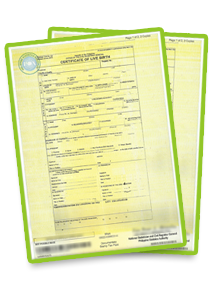
This record, officially maintained by the Philippine Statistics Authority (PSA) and accessible when you get a PSA certificate online (like a PSA birth certificate), is the ultimate legal authority. If you have a different surname you have “commonly used” for years, it does not matter. Your PSA birth certificate is the baseline.
When government agencies see a name mismatch, they will default to the PSA record. To fix the conflict, you must legally change or correct the name on your official document through a valid process, not just rely on custom or habit.
The Power of the PSA Birth Certificate
Think of the civil registry, which is managed by the Local Civil Registry Office (LCRO) and sent to the PSA, as the government’s master file on who you are. Because these documents are public records, they are legally presumed to be correct.
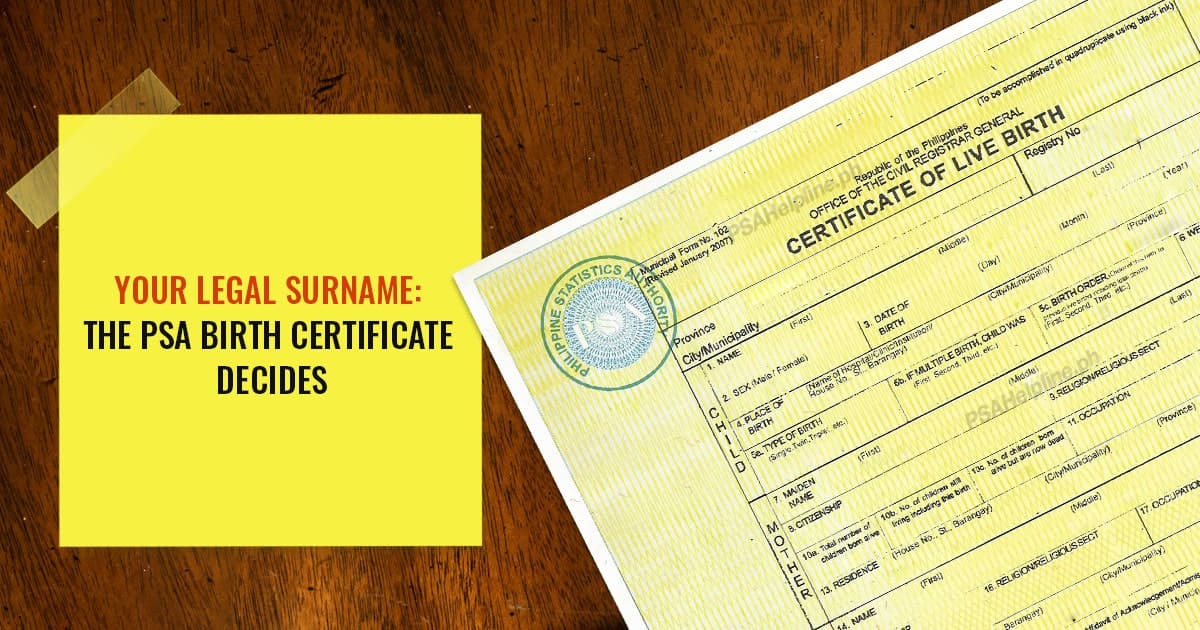
The Golden Rule: Your legal name is the one printed on your PSA birth certificate.
Unless you follow a specific legal process (like adoption, legitimation, or a proper change/correction case), using a different surname, even for decades, does not make it your legal name. In fact, habitually using an unauthorized alias in public life can even technically violate the Anti-Alias Law, a rule put in place to prevent fraud and confusion.
The Practical Reality: If you order your PSA online or get a PSA delivery, and that document shows a different name than your ID, the agency you are dealing with (like the DFA for a passport, or a bank) will always require you to fix the inconsistency. If the PSA birth certificate copy is erroneous, file the necessary corrections at the LCR the soonest possible time to prevent further delays in your important transactions.
The Essential Rules You Need to Know
1. The Right to a Name (Civil/Family Codes)
- Basic Identity: Your full name is your given name plus your surname (family name).
- Married Women’s Option: A wife has several choices and is not required to use her husband’s last name. She can continue using her maiden name, or choose a format that incorporates his name. Consistency is the main goal.
- Children’s Surnames:
- Legitimate children automatically bear the father’s surname.
- Illegitimate children traditionally used the mother’s surname, but thanks to R.A. 9255, they can now use the father’s surname if the father acknowledges paternity and the family files an Affidavit to Use the Surname of the Father (AUSF).
2. Fast-track Corrections (R.A. 9048 and R.A. 10172)
The law provides administrative routes (meaning, no court is needed) for simple mistakes:
- R.A. 9048: Corrects obvious clerical or typographical errors, and allows for a change of first name, but not your surname.
- R.A. 10172: Allows administrative correction of the day/month of birth and sex, but only if the error is clearly clerical.
You cannot change your surname just because you feel like it (except in the special case of an illegitimate child using the father’s surname under R.A. 9255).
3. The Court is Needed (Rule 103 and Rule 108)
If you want a substantial change, like completely changing your surname, establishing filiation, or correcting a major identity detail, you need to go to the Regional Trial Court (RTC):
- Rule 103 (Change of Name): Used for substantial changes, requiring you to show the court a “proper and reasonable cause”.
- Rule 108 (Correction of Entries): Used for correcting substantial mistakes in the civil registry, such as errors related to filiation that affect your surname.
Common Name Conflicts: Scenario Breakdown and Fixes
| Mismatch Scenario | Why The PSA Entry Prevails | The Fix |
|---|---|---|
| Used Father’s Surname, PSA Shows Mother’s Surname | You are likely an illegitimate child. The PSA birth certificate must be officially changed to reflect the father’s name. | If the father acknowledged you, immediately process the AUSF affidavit at the LCR. This is the fastest way to get your record annotated and lawfully take the father’s surname. |
| Married Woman Uses Maiden vs. Married Name | The law gives the wife an option. Inconsistent usage (maiden name on passport, married name on bank account) is the only problem. | Choose one consistent format (maiden or married) and align all IDs. To ensure smooth birth certificate delivery for children, your marriage record should also be consistent. |
| Adopted Person Still Uses Biological Surname | The court order and the amended PSA record (showing the adopter’s surname) are your new legal identity. | Stop using the old name and update all government IDs to match the PSA-amended surname. |
| Clerical Error (Misspelling) | Even a simple typo needs an official correction to prevent issues with PSA online transactions. | File an administrative petition for correction under R.A. 9048 with the LCR, supported by consistent older documents (baptismal, school records). |
| Different Surnames Across All IDs (No Clear Basis) | The last valid PSA-amended record will always be the deciding document. | You must decide which name you want to keep and pursue the appropriate legal process (AUSF, R.A. 9048, or a court case) to make it official on your PSA certificate online. |
The Official Routes to a Name Change
If your “used surname” does not match your PSA birth certificate, here is your quick decision guide:
| If your issue is: | Your Official Route: | What to do: |
|---|---|---|
| A simple misspelling/typo error | Administrative Correction (R.A. 9048/10172) | File petition at the Local Civil Registry (LCR) |
| Illegitimate Child seeking Father’s Surname | Administrative AUSF (R.A. 9255) | File Affidavit to Use the Surname of the Father at the LCR |
| New surname due to Adoption or Legitimation | Ensure Annotation is Complete | Check with PSA/LCR to make sure your amended record or annotation has been processed. |
| A major, non-clerical change (e.g., completely different surname, identity issue) | Judicial Petition (Rule 103/Rule 108) | File a court case at the Regional Trial Court (RTC) |
Once the LCR implements the change and the PSA annotates or amends your record (which you can verify by getting a new PSA delivery), you must then immediately update all your IDs.
Frequently Asked Questions:
Q: Can I still use my maiden name after getting married?
A: Absolutely. Philippine law gives a married woman the option to use her maiden name. Just choose one format (maiden or married) and use it consistently on all your official documents (passports, IDs, bank accounts).
Q: My father acknowledged me late. Can I change to his surname even as an adult?
A: Yes! R.A. 9255 applies to both minors and adults. As long as the documentary and acknowledgment requirements are met, an adult child can file the AUSF with their own consent.
Q: I have used a name for 20 years. Doesn’t that count?
A: Legally, no. Habitual use does not legally change your name. Without statutory or judicial authority attached to your PSA birth certificate, government agencies can and will lawfully refuse transactions that do not match the official PSA record.
Q: A judge granted my name change. Which name should I use now?
A: Use the new name. But first, ensure the court order has been implemented at the LCR and annotated on your PSA record. Once the PSA copy is updated, align all your IDs to the new legal name immediately.
Conclusion
The name on your PSA birth certificate is the one that counts. Period.
If you want your “used surname” to be your legal name, you must stop relying on custom and start utilizing law. Choose the correct pathway, whether it is the administrative AUSF for filiation issues, the fast-track R.A. 9048 for typos, or a full court case (Rule 103/108), get the PSA record updated, and then align all your personal, school, and work records to that new, legally recognized name.