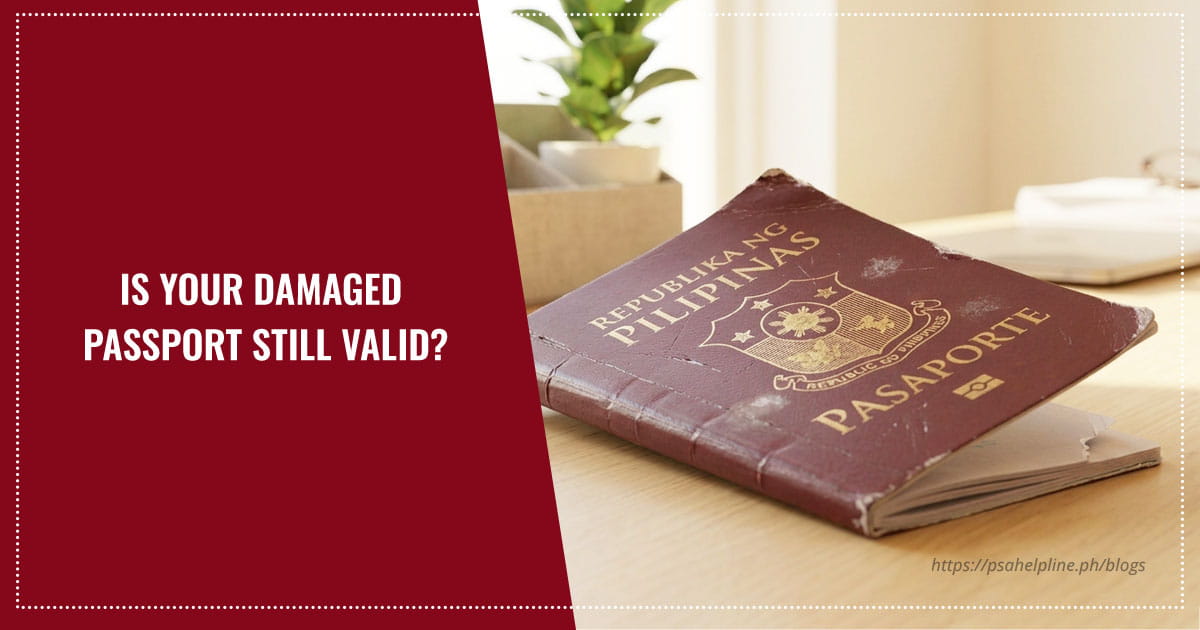
Imagine standing at the airport counter, luggage checked and boarding pass in hand, ready for a well-deserved vacation or crucial business trip. But during document inspection, the ground staff pauses, tilts your passport toward the light, and points out a small water stain on your photo page or a tiny tear along the spine. Just like that, your boarding privileges are suspended, and your departure hangs in the balance.
Many travelers mistakenly believe that as long as a passport has not been shredded or completely submerged, it remains valid. However, Philippine government guidelines and international aviation policies enforce zero-tolerance standards for document wear.
This guide details the physical flaws that render a travel document invalid, explains how ground crews handle questionable booklets, and outlines the exact procedure for obtaining a new passport at the Department of Foreign Affairs (DFA), including why securing an official PSA birth certificate through PSAHelpline.ph is the critical step in restoring your travel clearance.
Table of Contents
- Physical Defects That Render Your Passport Invalid
- Behind the Scenes: How Ground Staff Evaluate Questionable Booklets
- Step-by-Step Procedure to Replace a Mutilated Passport
- Documentary Requirements for DFA Replacement Applications
- The Essential Role of Your PSA Birth Certificate in Restoring Identity
- Skip the Lines: Request Civil Registry Records Online via PSAHelpline.ph
- Frequently Asked Questions (FAQs)
Physical Defects That Render Your Passport Invalid
Under the administrative guidelines of the Department of Foreign Affairs (DFA), a travel document is classified as mutilated if its physical structure, internal data chips, or printed details show compromise.
Even minor damage can trigger rejection at check-in counters or foreign immigration checkpoints under these specific conditions:
- Illegible Data Page: Scratches, smudges, fading, or peeling over your biographical details, passport number, or Machine Readable Zone (MRZ).
- Non-Functional Biometric Chip: Electrical or physical damage preventing contactless e-passport readers from fetching your stored biometrics.
- Obscured Facial Image: Watermarks, scratches, ink bleeds, or physical abrasions distorting your primary photograph.
- Incomplete Booklet: Any missing page, torn stub, or intentionally cut visa leaf.
- Structural Separation: A hard cover that has detached from the main block or hangs by frayed threads.
- Compromised Spine Sewing: Broken, frayed, or completely unstitched thread holding the interior signature together.
- Liquid Contamination: Warped pages, mold growth, or dissolved text caused by spilled coffee, rain, or accidental washing machine cycles.
- Unauthorized Inscriptions: Ink spots, accidental pen markings, toddler doodles, or unofficial stamps on data pages or visa sheets.
Behind the Scenes: How Ground Staff Evaluate Questionable Booklets
Airlines face heavy administrative fines, detention costs, and mandatory repatriation expenses if they transport a passenger with an invalid travel document to an international port. Consequently, airline check-in staff act as the first line of defense.
When an agent notices suspicious wear on a Philippine passport (such as on carriers like Cebu Pacific), they activate a standard evaluation protocol:
- Digital Evidence Capture: Ground agents photograph every damaged section of the booklet, focusing on data fields, binding integrity, and security features.
- Destination Authority Transmission: These images are uploaded directly to the destination country’s border control agencies or immigration officers on duty.
- The Final Clearance Verification: The airline holds boarding privileges until the receiving country confirms in writing that entry will be allowed. If foreign authorities decline, the airline issues a mandatory denial of boarding.
Step-by-Step Procedure to Replace a Mutilated Passport
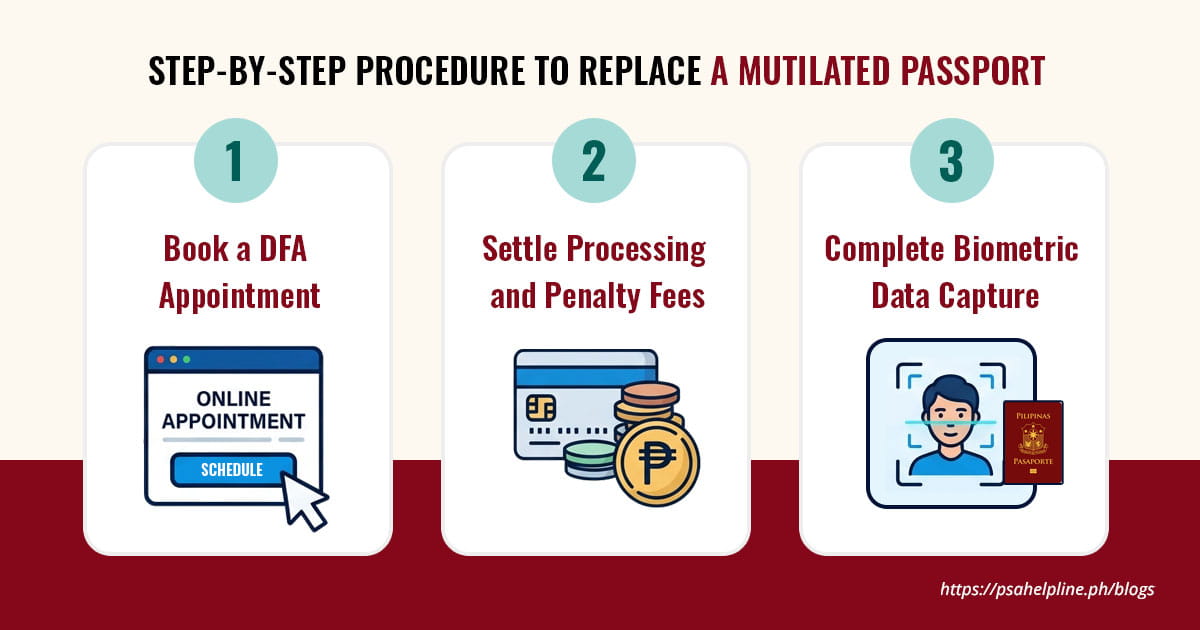
Because a damaged passport can no longer be processed through standard renewal routines, the replacement process mirrors a new application and carries an administrative penalty fee.
Step 1: Book a DFA Appointment
Access the official DFA Online Passport Appointment System and book an available slot at a convenient Consular Office or Temporary Off-Site Passport Service (TOPS) site. Select the appropriate classification for damaged or mutilated passport replacement.
Step 2: Settle Processing and Penalty Fees
Applicants replacing damaged travel documents must settle standard processing charges along with the mandatory penalty fee:
- Regular Turnaround: P950
- Expedited Turnaround: P1,200
- Mutilated Passport Penalty Fee: P350
Step 3: Complete Biometric Data Capture
Arrive at your chosen DFA site with your complete physical documents. Surrender the damaged booklet, undergo biometric and facial capture, and submit your notarized affidavit.
Documentary Requirements for DFA Replacement Applications
Gather these essential documents prior to attending your scheduled DFA appointment:
| Requirement | Purpose & Key Details |
|---|---|
| Printed DFA Application Form | Confirmed appointment schedule and completed form from the DFA portal. |
| Original Damaged Booklet | The physical mutilated passport (surrendered to consular officers) |
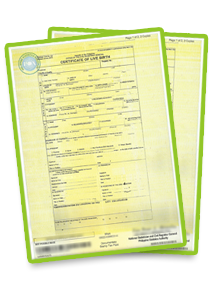
| PSA Birth Certificate | Authenticated copy printed on security paper. Order through PSA online via PSAHelpline.ph |
| PSA Marriage Certificate | Required for married female applicants updating or maintaining their married surname. |
| Valid Government-Issued ID | Original primary ID (e.g., UMID, Driver’s License, SSS, Postal ID) plus 1 clear photocopy. |
| Affidavit of Explanation | Original notarized document explaining the exact circumstances surrounding the passport damage. |
The Essential Role of Your PSA Birth Certificate in Restoring Identity
When a primary identity document like a passport suffers physical damage, consular and immigration officials must re-verify your biographical records against foundational government registries.
- Re-establishing Authenticity: Because damaged data pages or corrupted e-passport chips compromise built-in digital verifications, presenting a clear, official PSA birth certificate verifies your citizenship and personal information.
- Data Consistency: Whether resolving name spelling variations or presenting a PSA marriage certificate to maintain surname consistency, official civil registry documents ensure your passport details align perfectly with central government databases.
- Emergency Overseas Records: Maintaining accessible civil registry documents ensures you can verify your identity with embassies, consulates, or immigration agencies if document issues arise abroad.
Skip the Lines: Request Civil Registry Records Online via PSAHelpline.ph
If you need an official PSA birth certificate or marriage certificate for an upcoming DFA appointment, obtaining physical or digital records is fast and direct using PSAHelpline.ph.
- Order a Birth Certificate Online: Avoid long lines and physical queues by submitting your request through the PSAHelpline.ph web portal.
- Door-to-Door Delivery: Official documents printed on security paper are delivered straight to your home or office address.
- Official Digital Certificates: For instant digital submission needs, request an official PSA E-Certificate via PSAHelpline.ph. You receive an AATL-signed, tamper-proof digital PDF complete with a QR code designed for digital verification.
Ordering your PSA birth certificate online through PSAHelpline.ph ensures you have the necessary documentation ready prior to your scheduled DFA passport appointment.
Frequently Asked Questions (FAQs)
Why is a PSA birth certificate mandatory when replacing a damaged passport?
Because a damaged passport cannot be verified through standard automated system renewals, the DFA treats the case as a new application. Presenting an official PSA birth certificate re-establishes your foundational identity record in the government registry. You can order one easily through PSAHelpline.ph.
How do I order a PSA birth certificate online for my DFA application?
Go to PSAHelpline.ph, select “Birth Certificate”, input your information, choose your preferred payment method, and receive your document via home delivery. You may also choose to pick up the PSA certificate at participating National Book Store and Robinsons Department Store branches nationwide.
What is the difference between a paper PSA certificate and a PSA E-Certificate?
A paper PSA certificate is printed on official security paper and delivered to your physical address for hard-copy submission. A PSA E-Certificate issued through PSAHelpline.ph is an AATL-signed, tamper-evident digital file designed for digital submissions and online verification.
Is a Police Report required when applying for a damaged passport replacement?
No. Unlike a lost valid passport, replacing a mutilated passport does not require a Police Report. You only need to submit a notarized Affidavit of Explanation describing how the booklet was damaged.
How long does it take the DFA to issue a replacement passport?
Once you submit your requirements and pay the P350 penalty fee, DFA processing takes 12 working days for regular applications or 6 working days for expedited applications (within Metro Manila).