For many government employees and retirees, securing a pension or benefit involves more than completing an application. Depending on the transaction, applicants may also need to submit civil registry documents to establish a person's identity, confirm a family relationship, or document a death.
The Government Service Insurance System (GSIS) already offers digital services that allow members and pensioners to access certain transactions online. The PSA E-Certificate Service presents another opportunity to support this digital direction by making official Philippine Statistics Authority (PSA) civil registry documents available in digital form.
From funeral benefit claims and survivorship pensions to Annual Pensioners' Information Revalidation (APIR), there are potential applications worth exploring particularly where a PSA document may be required as supporting evidence.
This article examines how the PSA E-Certificate Service could complement GSIS processes, with a closer look at how CENODEATH may support APIR under a possible arrangement for direct digital transmission to GSIS.
Table of Contents
- Why Civil Registry Documents Matter to GSIS
- How GSIS Is Moving Toward Digital Services
- A. Funeral Benefit Claims
- B. Survivorship Pension Claims
- C. Retirement and Other Pension-Related Transactions
- D. Annual Pensioners' Information Revalidation (APIR)
- E. Establishing Family Relationships for Other GSIS Transactions
- How the PSA E-Certificate Service Could Benefit GSIS
- Frequently Asked Questions
Why Civil Registry Documents Matter to GSIS
GSIS administers social insurance benefits for government employees and their qualified beneficiaries. Depending on the benefit or transaction, establishing a person's identity, civil status, family relationship, or death may be necessary to determine eligibility and process a claim.
These details may be documented through official civil registry records, including:
- PSA Birth Certificate - may help establish identity, date of birth, or a parent-child relationship.
- PSA Marriage Certificate - may help establish a marital relationship when a spouse is applying for a benefit.
- PSA Death Certificate - may be required to document the death of a member, pensioner, or another person relevant to a claim.
- PSA CENODEATH (Certificate of No Death) - certifies that no corresponding death record was found in the PSA database based on its records search. This may be relevant to processes that require a death-record status check, subject to the receiving institution's requirements.
Not every GSIS transaction requires a PSA document, and the requirements depend on the specific benefit, the claimant's circumstances, and GSIS policies.
The opportunity, therefore, is not to introduce another requirement. It is to explore whether documents that are already needed for particular transactions can be obtained and transmitted through a more convenient digital process.
How GSIS Is Moving Toward Digital Services
GSIS has introduced digital channels to make services more accessible to members and pensioners. Its GSIS Touch mobile application brings together selected services, including access to pension-related transactions and online APIR facilities.
These initiatives provide a relevant starting point for exploring how digitally issued civil registry documents could complement existing GSIS processes.
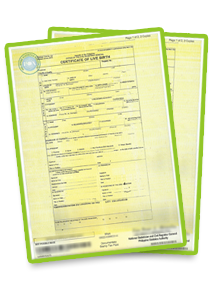
The PSA E-Certificate Service offers a digital version of an official PSA civil registry document. Available documents include birth, marriage, and death certificates, as well as CENOMAR and CENODEATH.
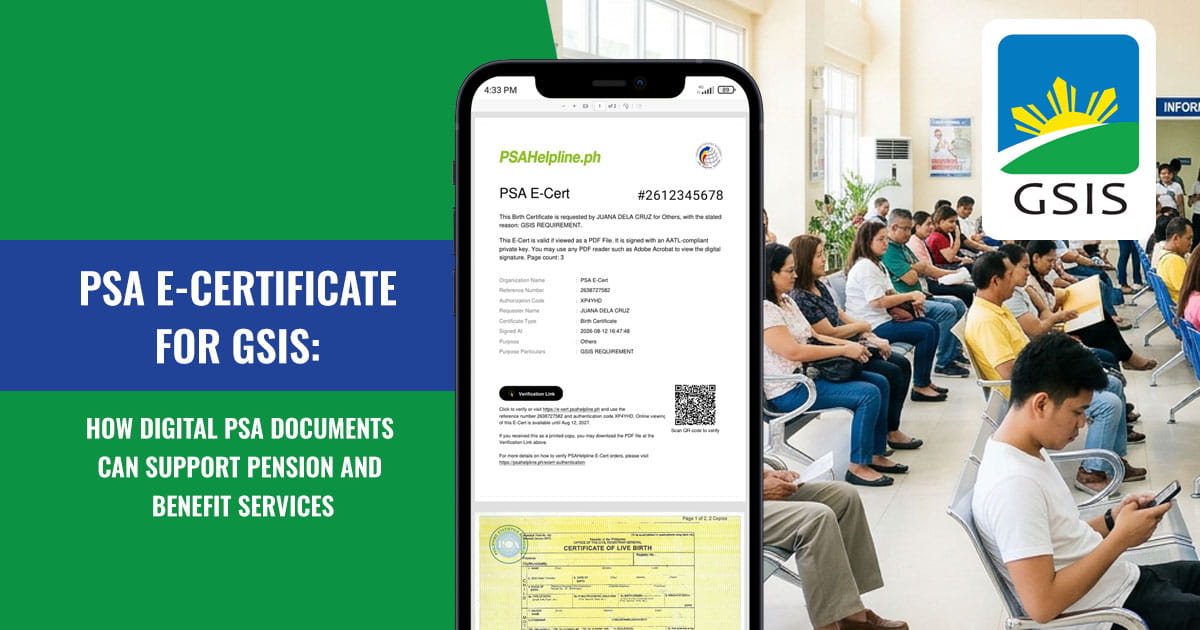
PSA E-Certificates are digitally signed PDF documents that can be checked through the designated verification portal. Through an appropriate institutional arrangement, the service could also support a process in which a digital certificate is transmitted to a participating institution rather than requiring the pensioner or claimant to submit it separately.
The specific transmission arrangements, document requirements, and acceptance procedures would need to be agreed upon by GSIS and PSAHelpline.
For background on the service, read Everything You Need to Know About the Official PSA E-Certificate.
A. Funeral Benefit Claims
Why this transaction is relevant: GSIS already identifies PSA or Local Civil Registry documents among the requirements for funeral benefit claims.
The GSIS funeral benefit helps cover funeral expenses following the death of an eligible member or pensioner. The documents required depend on the circumstances of the death and the person filing the claim.
According to the GSIS Funeral Benefit requirements, supporting documents may include:
- The deceased member's or pensioner's Death Certificate issued by the PSA or Local Civil Registry
- A Marriage Certificate when the surviving spouse is the claimant
- A Birth Certificate in certain cases involving a claimant who is not a GSIS member
- Other supporting documents based on the claimant's circumstances
GSIS also provides procedures for submitting claim documents electronically in applicable cases.
How the PSA E-Certificate could help
A digital PSA Death Certificate could offer an alternative way for an eligible claimant to obtain the required document. Instead of relying solely on a physical copy, the claimant could access the official digital document through the PSA E-Certificate Service, subject to the transaction's requirements.
If GSIS establishes a designated electronic submission or transmission process, the document could potentially be made available to GSIS through that arrangement.
The same approach could be explored for a Marriage Certificate or Birth Certificate when the relevant document is required to establish the claimant's relationship to the deceased.
The potential benefit is a more convenient document-submission process, especially for claimants who live far from PSA outlets or need to coordinate several requirements.
The PSA E-Certificate would support the documentary portion of the claim. GSIS would still determine eligibility, assess the other requirements, and process the benefit under its existing rules.
B. Survivorship Pension Claims
Why this transaction is relevant: Survivorship pension claims may involve documents that establish the relationship between a deceased GSIS member or pensioner and the person applying for benefits.
GSIS provides survivorship pension benefits to qualified beneficiaries under applicable rules. Depending on the case, a surviving spouse or qualified dependent child may be eligible.
The GSIS Survivorship Pension page explains the benefit and its eligibility framework.
Civil registry documents can be relevant when a claimant needs to establish a marital or parent-child relationship. For example:
- A Marriage Certificate may be required to establish the relationship between a deceased member or pensioner and a surviving spouse.
- A Birth Certificate may be relevant when establishing the relationship between a deceased member or pensioner and a dependent child.
The exact requirements depend on the claimant's circumstances and GSIS rules.
How the PSA E-Certificate could help
The PSA E-Certificate Service could provide another way for qualified claimants to obtain these supporting documents in digital form.
For claimants who need to gather several documents, the ability to obtain a digital PSA certificate may make document preparation more convenient. If an approved digital submission or institutional transmission process is established, it could also help reduce the need for separate physical document handling.
This is particularly worth exploring for beneficiaries who live outside major urban centers or who may find repeated trips to obtain documents difficult.
The digital certificate would serve as supporting documentation. It would not automatically establish entitlement to a survivorship pension or replace GSIS' assessment of the claim.
C. Retirement and Other Pension-Related Transactions
Why this transaction is relevant: Some pension-related cases may require civil registry documents, although these should not be treated as universal requirements for retirement applications.
GSIS retirement benefits are governed by the applicable retirement laws and benefit rules. The documents needed depend on the type of benefit and the member's circumstances.
A Birth Certificate, Marriage Certificate, or another civil registry document may be requested in particular cases, for example when personal details need to be verified or a family relationship is relevant to a benefit or subsequent claim.
It would be inaccurate to suggest that every GSIS retirement application requires a PSA certificate. The opportunity is more specific: where GSIS already requires a civil registry document, a digital option could be considered.
How the PSA E-Certificate could help
The PSA E-Certificate Service could give members and pensioners another way to obtain a required civil registry document without relying exclusively on a physical copy.
For applicable transactions, a digital certificate may help simplify the document-gathering process. An agreed electronic submission arrangement could also be explored where GSIS permits or requires the relevant supporting record.
The appropriate use cases would need to be identified with GSIS to ensure that the digital document fits the actual requirements of each transaction.
D. Annual Pensioners' Information Revalidation (APIR)
Why this transaction is relevant: APIR is an existing GSIS process for confirming a pensioner's continuing eligibility and active status. The PSA E-Certificate Service could potentially support this process through digital access to CENODEATH.
APIR helps GSIS verify the status of pensioners and maintain the accuracy of its pension records. GSIS has introduced online options for pensioners to complete certain APIR requirements, including through its digital services.
This creates an opportunity to explore whether an official PSA certificate could provide an additional source of documentary information for the process.
How CENODEATH could support APIR
CENODEATH is a PSA certification stating that, based on a search of the PSA database, no corresponding death record was found for the individual. It is available through the PSA E-Certificate Service.
For GSIS pensioners, the document may be relevant to discussions about the Annual Pensioner's Information Revalidation (APIR) process, particularly in exploring how digital civil registry documents could support pension-related transactions.
Any use of CENODEATH for APIR would depend on GSIS requirements and its assessment of the document. The certificate should be treated only as a possible supporting document, not as proof that a pensioner is alive or as a replacement for APIR.
Digital access to PSA civil registry documents may offer pensioners an additional way to obtain relevant records when needed. Whether a particular document can be submitted for APIR, and how it should be presented or verified, remains subject to GSIS policies and procedures.
Why Direct Digital Transmission Matters
If implemented, direct transmission could reduce the need for pensioners to separately obtain a document and then manage its submission to GSIS. It could also give GSIS a more structured way to receive the certificate for its intended use.
For pensioners living in remote areas, those with mobility challenges, or those who find in-person transactions difficult, a digital document process could offer practical assistance.
For GSIS, an agreed electronic workflow could help organize document receipt and verification while supporting the institution's broader digital service initiatives.
An Important Distinction: CENODEATH is Not Proof of Life
CENODEATH should be understood according to what it certifies: that no corresponding death record was found in the PSA database based on the search conducted. It does not, on its own, conclusively establish that a person is alive.
The absence of a death record in the PSA database is not the same as a definitive confirmation of a person's current status. For that reason, CENODEATH should not be presented as a standalone replacement for APIR, nor should ordering the certificate be represented as automatic compliance with APIR.
Instead, the opportunity is to explore whether CENODEATH can serve as an additional supporting document within a GSIS-approved APIR process, alongside any identity verification, declarations, record checks, or other requirements that GSIS determines are necessary.
The final process, including whether CENODEATH is required, optional, or suitable only for certain cases, would need to be determined by GSIS.
E. Establishing Family Relationships for Other GSIS Transactions
Why this transaction is relevant: Some GSIS services extend to qualified family members or other individuals whose relationship to a GSIS member or pensioner must be established.
One example is the GSIS Auto Shield motor vehicle insurance program. GSIS identifies documentary proof of relationship, such as a PSA birth certificate or marriage certificate, among the documents that may be required for certain non-member applicants who are related to a GSIS member or pensioner.
The requirements depend on the applicant's relationship and the applicable program rules. More information is available on the GSIS Auto Shield page.
How the PSA E-Certificate could help
Where a PSA Birth Certificate or Marriage Certificate is required, the PSA E-Certificate Service could provide a digital option for obtaining the supporting document.
This may be useful when the person completing the transaction is not a GSIS member but needs to establish a qualifying relationship with one.
The broader opportunity is to identify other GSIS services with similar documentary requirements and determine whether digital PSA certificates could support them. Such use cases should be confirmed individually rather than assuming that the same document is required across all GSIS services.
How the PSA E-Certificate Service Could Benefit GSIS
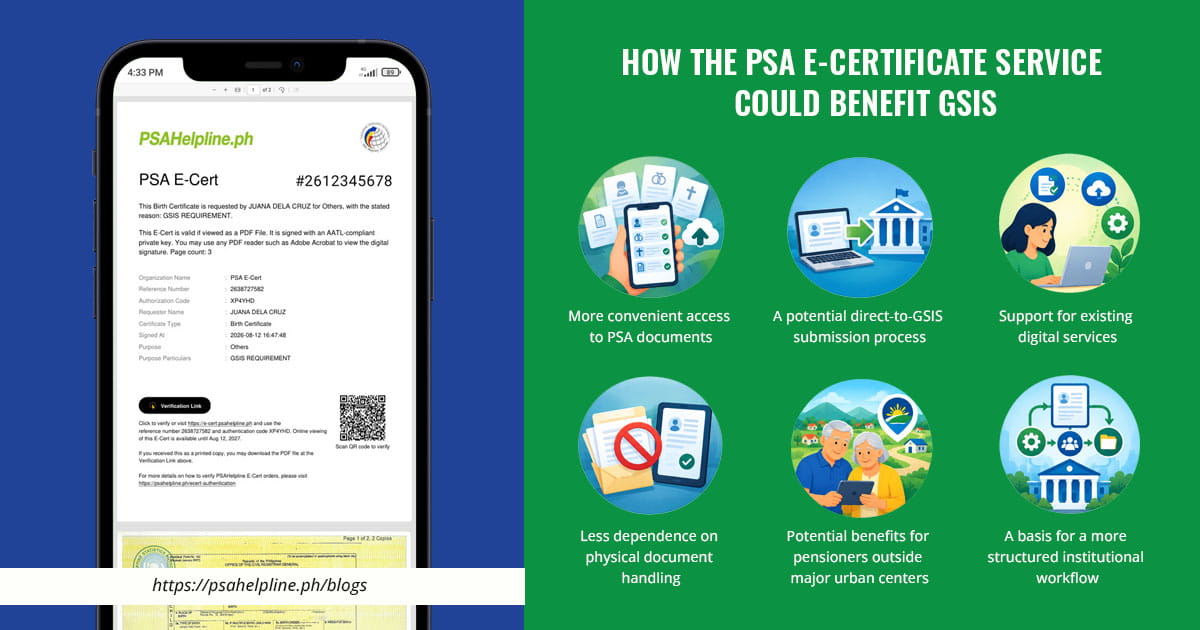
The potential value of the PSA E-Certificate service goes beyond making a document available in PDF format. If integrated into appropriate GSIS workflows, it could help address practical challenges in obtaining and submitting civil registry records.
More convenient access to PSA documents
Members, pensioners, and beneficiaries could order the required digital PSA certificate online, subject to the document's availability and the service's requirements.
A potential direct-to-GSIS submission process
Selected documents could be transmitted electronically to GSIS instead of requiring pensioners or claimants to handle each submission separately.
This could be especially useful for an APIR-related CENODEATH workflow, if GSIS determines that the document is appropriate for that purpose.
Support for existing digital services
GSIS already offers online services for selected member and pensioner transactions. A digital PSA document process could complement these services where civil registry records are part of the existing requirements.
Less dependence on physical document handling
For applicable transactions, a digital certificate may reduce the need to obtain and submit a printed copy. Whether a printed document is still necessary would depend on GSIS requirements and the transaction involved.
Potential benefits for pensioners outside major urban centers
Online access to civil registry documents could help pensioners and beneficiaries who face travel or mobility challenges. A direct transmission arrangement, if implemented, could further reduce the steps required to submit a supporting document.
A basis for a more structured institutional workflow
A formal arrangement could define how documents are ordered, transmitted, received, matched to GSIS records, and checked. This would help ensure that convenience is supported by clear procedures and appropriate safeguards.
These are potential benefits, not a claim that all GSIS transactions can already be completed through the PSA E-Certificate Service. The actual scope would depend on GSIS requirements and any agreed implementation.
Frequently Asked Questions
What is the PSA E-Certificate Service?
The PSA E-Certificate Service provides digital versions of official PSA civil registry documents, including Birth, Marriage, and Death certificates, CENOMAR, and CENODEATH. The digital certificates are issued as digitally signed PDF documents and can be checked through the designated verification portal.
Learn more in Everything You Need to Know About the Official PSA E-Certificate.
Can the PSA E-Certificate Service be used for GSIS transactions?
The service could support GSIS transactions that require civil registry documents, such as certain funeral benefit claims, survivorship pension claims, or transactions involving proof of a family relationship. The document requirements and acceptance procedures must be confirmed with GSIS for each transaction.
How could CENODEATH support GSIS APIR?
CENODEATH certifies that no corresponding death record was found in the PSA database based on its records search. Under a proposed arrangement, a pensioner could order the digital certificate and have it transmitted directly to GSIS through an agreed secure channel. GSIS could then determine whether and how to use it as an additional supporting document within APIR.
Does CENODEATH prove that a pensioner is alive?
No. CENODEATH indicates that no corresponding death record was found in the PSA database. It is not conclusive proof that a person is alive and should not be treated as a standalone substitute for APIR or other GSIS validation procedures.
Can pensioners currently have their PSA E-Certificates sent directly to GSIS?
A direct-to-GSIS transmission arrangement for APIR would need to be confirmed and established by GSIS and PSAHelpline. It should not be assumed to be an existing, generally available service. If the parties agree to implement it, the ordering, transmission, and verification procedures would need to be defined.
Would a PSA E-Certificate automatically satisfy GSIS requirements?
No. A digital PSA certificate may serve as supporting documentation where accepted, but it does not automatically establish eligibility for a benefit or satisfy every requirement of a GSIS transaction. GSIS retains authority over its requirements, verification procedures, and benefit decisions.
Supporting Digital Pension and Benefit Services
The PSA E-Certificate Service offers an opportunity to complement GSIS' digital service initiatives by making official civil registry documents accessible in digital form.
Funeral benefit claims, survivorship pension claims, and other transactions that require proof of identity, death, or family relationships are practical areas to examine. APIR is another potential use case, particularly if GSIS determines that CENODEATH can serve as an additional supporting document and establishes an appropriate direct-transmission process with PSAHelpline.
The next step is to work with GSIS to identify the most relevant transactions, clarify the role of each document, and define a secure and practical workflow. With the right arrangements, the service could help make obtaining and submitting PSA documents more convenient for pensioners, members, and beneficiaries, while preserving GSIS' existing eligibility checks and responsibilities.