The Philippines is moving toward a more digital government. From online applications and electronic payments to digital identities, government portals, and electronic document processing, more public services are being designed to work online.
This transformation is not limited to one government agency or one type of transaction. National government agencies, local government units, government-owned and controlled corporations, state universities and colleges, and other government institutions are progressively adopting digital systems to make their services more accessible and efficient.
As more government transactions move online, the documents people use in those transactions must also be able to move securely into the digital environment. This is where the PSA E-Certificate becomes particularly relevant.
Table of Contents
- The Philippines Is Moving Toward E-Governance
- What Is Driving Government Digitization?
- Digital Government Is More Than Putting Forms Online
- The Role of Digital Documents in Government Transactions
- Where the PSA E-Certificate Fits Into a Digital Philippines
- What Makes the PSA E-Certificate Suitable for Digital Transactions?
- How Government Agencies Can Verify a PSA E-Certificate
- From Physical Queues to Digital Transactions
- Government Agencies and the Growing Digital Ecosystem
- The Judiciary's Digital Transformation
- What This Means for Filipinos
- PSA E-Certificate and the Future of Government Transactions
- Frequently Asked Questions
The Philippines Is Moving Toward E-Governance
The country's transition toward digital government is no longer simply a matter of individual agencies creating websites or offering downloadable forms. The government is working toward a more integrated approach to electronic governance.
Republic Act No. 12254, or the E-Governance Act, institutionalizes the transition of the Philippine government to e-governance. The law establishes a framework for a digitally empowered and integrated government and calls for citizen-centered online government services, greater interoperability among government systems, and the use of technology to improve efficiency, data security, and public access to government services.
The law also provides for an E-Government Master Plan that will serve as the overarching roadmap for the development and enhancement of electronic government services and processes across the bureaucracy. Its implementing rules further emphasize a whole-of-government approach to digital transformation.
In practical terms, this means that Filipinos can expect more government transactions to involve digital platforms, electronic submissions, online verification, and interconnected systems.
What Is Driving Government Digitization?
Government digitization is being driven by several practical needs.
Making Government Services More Accessible
Digital services can allow people to initiate or complete certain government transactions without having to travel to an office simply to submit a form or document.
For people living far from government offices, overseas Filipinos, senior citizens, persons with disabilities, and people balancing work or school schedules, the ability to transact online can make government services more accessible.
Reducing Unnecessary Paperwork
Many traditional government processes involve printed forms, photocopies, physical supporting documents, and repeated submissions. Digitization provides opportunities to reduce unnecessary paper handling where electronic documents and processes are legally and operationally appropriate.
Improving Processing and Verification
Digital systems can also make it easier for government offices to receive information, route applications, track transactions, and verify documents.
Building More Connected Government Services
The direction is increasingly toward government systems that can work together rather than requiring citizens to repeatedly provide the same information to different offices.
The E-Governance Act specifically promotes interoperability among government systems and establishes programs intended to integrate frontline government services. It identifies agencies including the PSA, DFA, LTO, LTFRB, NBI, PRC, DTI, SEC, BSP, BIR, GSIS, SSS, Pag-IBIG, and PhilHealth among those whose frontline services may be integrated into a common platform.
Digital Government Is More Than Putting Forms Online
Digitizing government does not simply mean converting a paper form into a PDF or putting an application form on a website.
A genuinely digital transaction also needs ways to establish identity, protect sensitive information, authenticate documents, receive payments, communicate with the user, and verify information.
For example, a person applying for a government service online may need to:
- Prove who they are
- Submit supporting documents digitally
- Pay online
- Receive notifications electronically
- Track the status of the transaction
- Provide information securely
- Allow the receiving agency to verify submitted documents
This is why official digital documents are an important part of the country's broader digital transformation.
If government processes increasingly happen online but the supporting documents still have to be obtained physically, scanned, photocopied, and manually submitted, part of the transaction remains tied to the old paper-based process.
The Role of Digital Documents in Government Transactions
Consider a simple example. A government agency moves an application process online. An applicant can fill out the form, upload requirements, pay electronically, and receive updates online. But the application requires a PSA birth certificate.
If the applicant must first obtain a printed certificate, wait for it to arrive, scan or photograph it, and then upload the resulting file, the document itself becomes the remaining physical step in an otherwise digital transaction.
The PSA E-Certificate provides another option.
Instead of creating a digital copy of a physical certificate themselves, applicants can request an officially issued PSA E-Certificate that is already in digital PDF format and includes security and verification features.
This is one of the reasons the PSA E-Certificate is relevant to the government's broader digitalization efforts: it allows an official civil registry document to participate directly in digital transactions.
For a complete explanation of the PSA E-Certificate, including its available documents, ordering process, security features, and access period, see our PSA E-Certificate Complete Guide.
Where the PSA E-Certificate Fits Into a Digital Philippines
The PSA is responsible for maintaining and issuing vital civil registry documents and certifications that Filipinos routinely need for government, education, employment, travel, legal, and other transactions.
These documents include birth certificates, marriage certificates, death certificates, CENOMARs, and CENODEATHs.
As government services become increasingly digital, these documents also need a secure way to exist and be submitted in digital transactions.
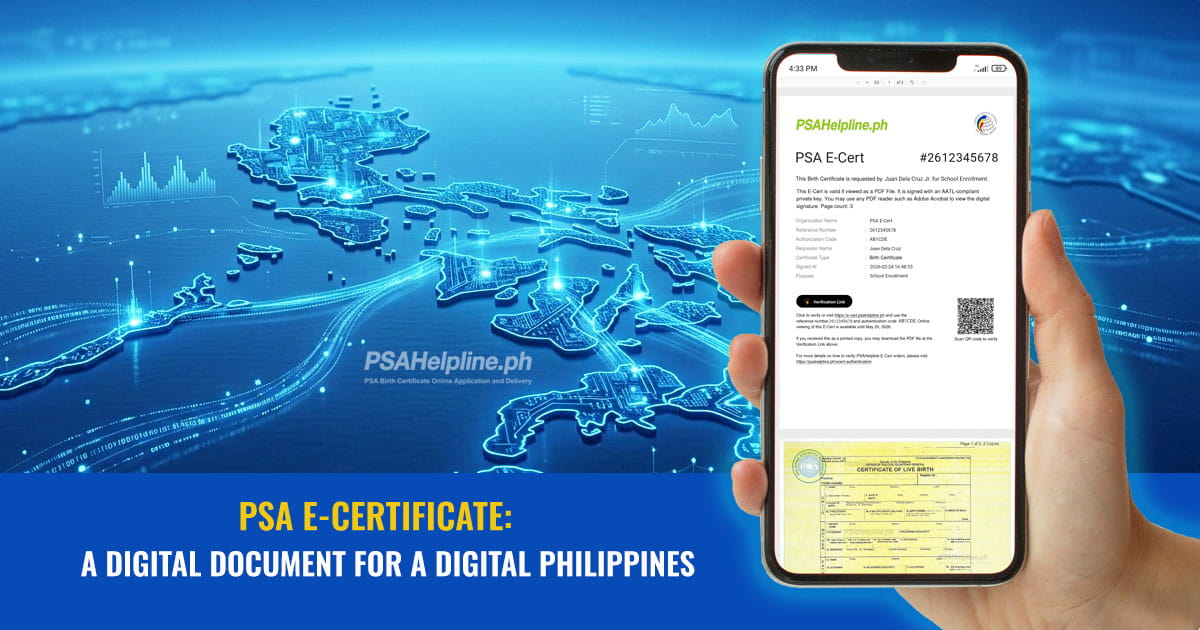
The PSA E-Certificate addresses this need by providing a digital copy of the PSA-issued civil registry document or certification in PDF format. It is delivered through a secure access link and includes features that allow receiving institutions to verify its authenticity.
The PSA launched its E-Certificate Service on February 25, 2026, as part of its continuing efforts toward digital transformation, data privacy, security, and more convenient access to vital documents.
The service is available through PSAHelpline.ph and through the eGovPH superapp's PSA online ordering service.
A Digital Certificate for a Digital Transaction
The concept is straightforward:
Digital government service + digital application + digital submission + digitally verifiable official document = a more complete digital transaction.
The PSA E-Certificate does not by itself make an entire government transaction digital. Rather, it provides one important component: the official civil registry document in a format designed for digital use.
What Makes the PSA E-Certificate Suitable for Digital Transactions?
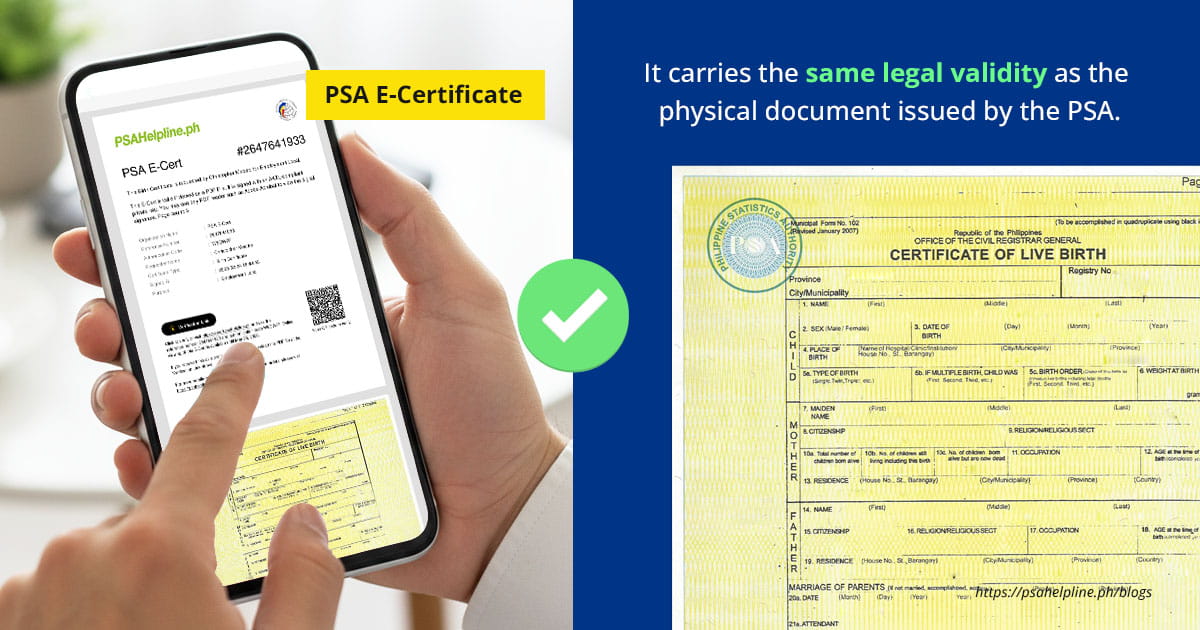
An ordinary photograph or scan of a printed PSA certificate is simply a digital image of a physical document. The PSA E-Certificate is different.
The PSA has described the E-Certificate as the exact digital scanned copy of the physical document printed on PSA security paper, provided in PDF format. It carries the same legal validity as the physical document issued by the PSA, subject to applicable laws, regulations, and institutional requirements.
The E-Certificate also incorporates security and verification mechanisms that are important when official documents are submitted electronically.
Digital Security
The PSA E-Certificate is cryptographically secured, helping protect the integrity of the digital document.
QR Code Verification
A QR code appears on the cover page and can be scanned to access the official verification mechanism.
Reference Number and Authorization Code
The E-Certificate also contains information that can be used for manual verification through the official PSA E-Certificate verification portal.
Secure Access
Because civil registry documents contain sensitive personal information, the service includes an identity verification process before the requester can access the E-Certificate.
These features are particularly important in a digital government environment, where an institution may receive a document electronically without ever seeing the original physical copy.
How Government Agencies Can Verify a PSA E-Certificate
Digital government requires digital trust. A government agency accepting a document electronically needs a reliable way to determine whether the document is genuine.
The PSA E-Certificate provides two ways to verify the document.
Option 1: QR Code
An authorized receiving party can scan the QR code displayed on the E-Certificate's cover page. This leads to the official PSA E-Certificate verification portal, where the document can be checked.
Option 2: E-Certificate Verification Portal
The receiving institution can also access the official verification portal and enter the Reference Number and Authorization Code shown on the E-Certificate.
This allows agencies and other institutions to verify the authenticity of the document rather than relying solely on the appearance of a PDF file submitted by an applicant.
For a more detailed explanation of the two verification methods, see our Complete PSA E-Certificate Guide.
From Physical Queues to Digital Transactions
The benefits of digital government become most visible when a transaction that previously required several physical steps can be completed through digital channels.
A traditional transaction might involve:
- Visit an office
- Request a document
- Receive a printed copy
- Scan or photocopy the document
- Bring or submit it to another office
A digitally enabled transaction can potentially look more like:
- Request online
- Receive the official digital document
- Submit electronically
- Verify online
Not every government transaction can or should be completely digital. Some processes will continue to require physical appearances, original documents, biometrics, signatures, or other safeguards. But where electronic documents are permitted, digital alternatives can remove unnecessary physical steps.
The PSA E-Certificate is designed for this type of environment.
Government Agencies and the Growing Digital Ecosystem
The move toward digital government is taking place across different sectors rather than within a single agency.
The DICT's government digital platforms include systems supporting areas such as identity verification, payments, health, travel, business, citizen reporting, local government services, electronic documents, electronic signatures, and other government functions.
The E-Governance Act likewise establishes a framework for integrating government frontline services and improving interoperability among government systems.
This broader ecosystem matters because government transactions rarely involve just one document or one institution. A person may interact with several agencies throughout a single life event. For example: getting married, having a child, applying for employment, pursuing professional registration, or processing legal and administrative requirements.
As these transactions become increasingly digital, official supporting documents must also be capable of being securely submitted and verified online.
The Judiciary's Digital Transformation
The digital transformation of government extends beyond executive-branch agencies. The Philippine Judiciary is also working toward more technologically adaptive court systems and processes.
The Supreme Court's Strategic Plan for Judicial Innovations 2022-2027 identifies technological adaptation as one of the principles guiding the modernization of the Judiciary. The plan aims to improve efficiency through streamlined court systems, innovation through ICT infrastructure, and access through more inclusive and transparent systems and procedures.
One example is eCourt PH, the Judiciary's electronic filing and case management system. It provides an online environment where lawyers can file cases, upload pleadings, and track case progress. The Philippine Judiciary Platform serves as the online access point for Judiciary ICT applications.
The significance goes beyond the Judiciary itself. It illustrates a broader reality: even highly formal and document-intensive government processes are increasingly being adapted for digital environments.
When government systems become digital, the ability to authenticate documents electronically becomes increasingly important.
What This Means for Filipinos
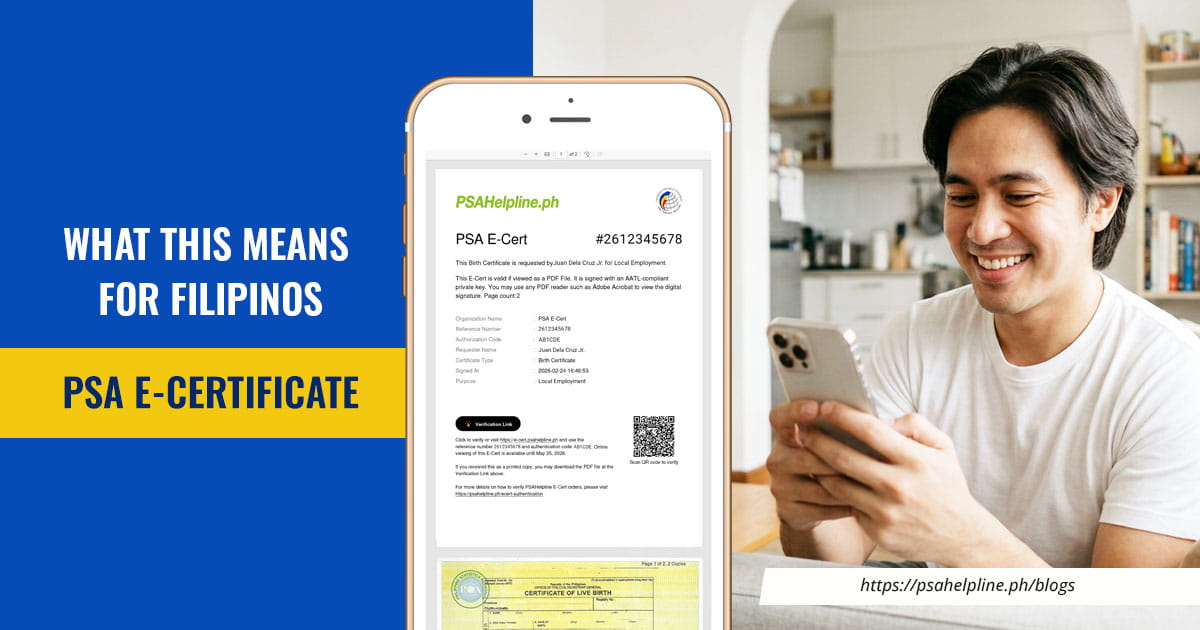
For ordinary Filipinos, government digitalization can mean fewer trips to government offices, fewer physical documents to carry, and more opportunities to complete transactions online.
It can also mean that people need to become familiar with a new kind of government transaction, one where a digital document can be just as important as the physical document it represents.
This is particularly relevant for documents such as PSA civil registry records, which Filipinos may need repeatedly throughout their lives.
A PSA birth certificate, for example, can be needed for school enrollment, employment, government applications, professional requirements, legal transactions, and other purposes. A marriage certificate may be required for government benefits, insurance, legal matters, or changes in records. CENOMARs and other certifications may be requested for applications and transactions that require proof of civil status.
Having an official digital option can therefore be useful not just for one particular transaction, but throughout a person's interaction with government and other institutions.
PSA E-Certificate and the Future of Government Transactions
The PSA E-Certificate is part of a larger shift in how Filipinos obtain, submit, and verify official documents.
As the country moves toward e-governance, the goal is not simply to replace paper with PDF files. It is to create digital processes that remain secure, verifiable, accessible, and trustworthy.
The PSA E-Certificate contributes to that goal by providing an official PSA civil registry document in a digital format, together with mechanisms that allow institutions to verify its authenticity.
For government agencies, this can provide another option for handling PSA documentary requirements in digital transactions. For citizens, it can mean having an official PSA document that is ready for electronic submission when the receiving institution accepts digital E-Certificates.
The PSA's memorandum on the acceptance of PSA E-Certificates further supports this direction by enjoining government agencies and instrumentalities to recognize and accept PSA E-Certificates as valid civil registry documents for official transactions, subject to applicable laws, regulations, and institutional policies. The private sector is likewise encouraged to accept them.
As more government services move online, the value of an official, digitally verifiable PSA document can only become more apparent.
Frequently Asked Questions
What is the PSA E-Certificate?
The PSA E-Certificate is the official digital scanned copy of a PSA civil registry document or certification. It is provided as a PDF through a secure access link and includes features that allow the document to be verified online.
Why is the PSA E-Certificate important to digital government?
As government transactions move online, citizens increasingly need to submit official documents electronically. The PSA E-Certificate provides an official digital format for PSA civil registry documents that can be submitted electronically when accepted and verified online.
Is the PSA E-Certificate the same as a scanned copy of a printed PSA certificate?
No. Although the E-Certificate is the exact digital scanned copy of the physical document printed on PSA security paper, it is an officially issued digital document with security and verification features. An ordinary scan or photograph of a printed certificate does not have the same official digital verification mechanism.
Which PSA documents are available as E-Certificates?
The PSA E-Certificate Service covers Birth, Marriage, and Death Certificates, as well as CENOMAR and CENODEATH.
Can I use a PSA E-Certificate for government transactions?
Yes, when the particular government agency accepts PSA E-Certificates for the transaction. The PSA has enjoined government agencies and instrumentalities to recognize and accept PSA E-Certificates as valid civil registry documents for official transactions, subject to applicable laws, regulations, and institutional policies.
Do private institutions also accept PSA E-Certificates?
The PSA encourages private institutions to accept PSA E-Certificates. However, individual organizations may have their own documentary requirements, so applicants should confirm acceptance with the institution handling their transaction.
How can a government agency verify a PSA E-Certificate?
The receiving agency can scan the QR code on the E-Certificate's cover page or use the official PSA E-Certificate verification portal and enter the Reference Number and Authorization Code shown on the document.
Is the PSA E-Certificate legally valid?
The PSA has stated that the E-Certificate is the exact digital scanned copy of the physical document printed on security paper and carries the same legal validity as the corresponding physical document issued by the PSA, subject to applicable laws, regulations, and institutional requirements.
Does the PSA E-Certificate replace printed PSA certificates?
No. The E-Certificate provides a digital option but does not eliminate the printed PSA certificate. Some transactions may still require a physical copy. The appropriate format depends on the requirements of the receiving institution.
Where can I get a PSA E-Certificate?
You can request a PSA E-Certificate through PSAHelpline.ph. The PSA E-Certificate Service is also accessible through the eGovPH superapp's PSA online ordering service.
How long is the PSA E-Certificate available?
The E-Certificate is initially available through the Customer Service Portal for up to one year from the date the document was scanned. Once the client downloads it, the 60-day viewable period begins. The e-certificate will be purged from the system after the 60-day viewable period in compliance with the Data Privacy Act of 2012.
Is the PSA E-Certificate only useful for government transactions?
No. The PSA E-Certificate can also be useful for private-sector transactions and institutional requirements when the receiving organization accepts digital PSA documents. Schools, employers, banks, and other organizations may use the verification mechanism to authenticate submitted E-Certificates.